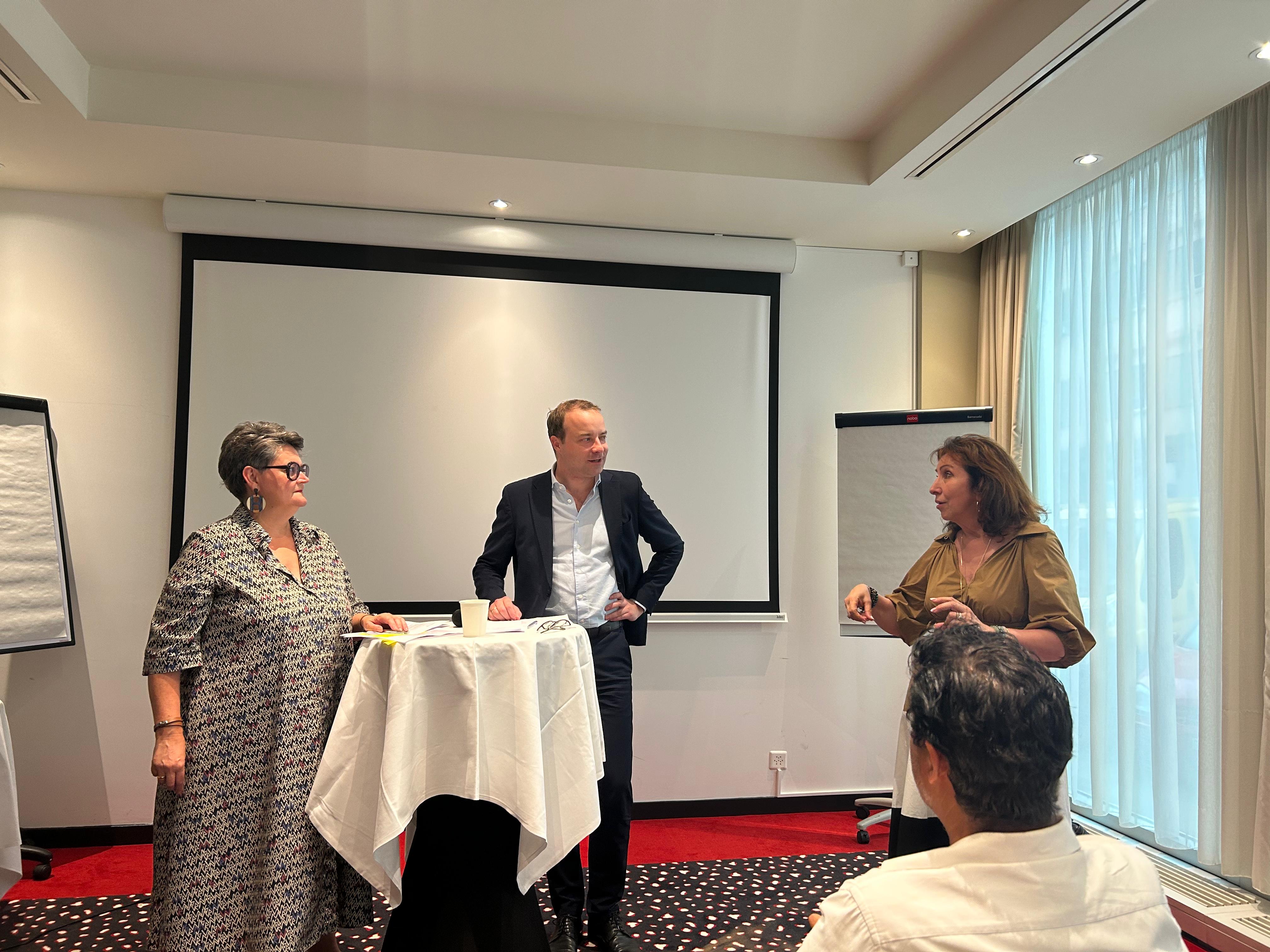
On 29 June, the Cercle des Dirigeants d'Entreprises invited me to debate Swiss neutrality alongside Cristina Gaggini, Director for French-speaking Switzerland at Economiesuisse. The evening, organized in partnership with Thémisia Gioia, was introduced by Laurent Franceschetti. The objective was simple: to make the issues surrounding the referendum of 27 September understandable to an audience of business leaders, without slogans and without preconceived judgments.
The subject is well known. The initiative "Safeguarding Swiss Neutrality," submitted by Pro Suisse and members of the Swiss People's Party (UDC/SVP), seeks to define Swiss neutrality as "perpetual and armed," prohibit participation in foreign wars, and forbid economic or diplomatic sanctions against a belligerent state, subject to Switzerland's obligations toward the United Nations. In Parliament, the proposal was categorically rejected, and the idea of a counter-proposal, which had been more widely debated, was ultimately abandoned. The people will decide.
I wanted to put forward three ideas.
First, neutrality must be understood on several levels. The first is the legal level: the Hague Conventions of 1907 codify the obligations of a neutral state in times of armed conflict, and from this strictly legal point of view, Switzerland has never ceased to be neutral. The second level is more demanding: a state is neutral only if others recognize it as such. This requires genuine independence, credibility built over time, and diplomatic consistency. The third level would be complete isolation—a neutrality that is perfect on paper but of no international usefulness whatsoever. No one in Geneva can wish for that. Switzerland's entire room for manoeuvre lies between these first two levels, and that is precisely where the debate of 27 September should be focused.
Secondly, the real question is not whether Switzerland should remain neutral—no one disputes that—but whether constitutional rigidity creates credibility. My conviction, as an engineer, is that a legal norm does not create trust; practice creates trust. A rule carved in stone establishes a position; it does not guarantee that others will believe us. Conversely, a flexible but inconsistent neutrality policy erodes the capital of trust just as surely. The Swiss debate would benefit from moving beyond the alternative of "too neutral" versus "not neutral enough" and instead asking the only operational question that truly matters: What instruments do we want to keep in our hands for the next twenty years?
Finally, Geneva is tangible proof of what neutrality produces. Switzerland continues to represent diplomatic interests between Iran and the United States, between Cuba and the United States, between Canada and Iran, and between Russia and Georgia. When the recent discussions between Washington and Tehran took place, they were held in Geneva. This ecosystem—diplomatic, humanitarian, legal, financial, and academic—is a strategic asset that is difficult to rebuild once it has been allowed to deteriorate. Yet successive budget cuts have accumulated: the Geneva Centre for Security Policy has been reduced proportionally more than other federal institutions; the Federal Department of Foreign Affairs has lost seventy-seven positions; and International Geneva was saved only at the very last moment through an emergency credit. Neutrality cannot be defended by means of a constitutional sentence if, at the same time, the infrastructure that makes it useful is being dismantled.
I added a fourth point, which was not part of the referendum itself but goes beyond it: there can be no credible neutrality in the twenty-first century without digital sovereignty. Our data, our cloud infrastructure, and our cybersecurity capabilities are today largely dependent on foreign actors. A country whose critical infrastructure is controlled elsewhere does not determine its foreign policy independently. This is precisely the purpose of the Geneva Center for Neutrality's work on the Digital Manifesto and the Neutral Tech Label: to extend the spirit of Geneva into cyberspace rather than importing rules designed elsewhere.
Cristina Gaggini brought to the discussion the economic perspective, which speaks most directly to an audience of business leaders. Her argument began from a simple observation: Swiss prosperity is based on an open, export-oriented economy integrated into international value chains. Within this framework, the predictability and freedom of action of the Federal Council are economic assets, just as much as legal stability or the quality of infrastructure. Enshrining a general prohibition on sanctions in the Constitution would deprive Switzerland of an important instrument of foreign policy and expose it to friction with its principal trading partners—the European Union and the United States above all—as well as to reputational risks for its financial centre. Her conclusion reflected that of the organized business community: neutrality is an instrument serving the interests of the country, not an end in itself, and making that instrument more rigid inevitably reduces its usefulness. Our analyses differed in emphasis, not in methodology. Where the economic approach places primary importance on preserving room for manoeuvre, my own approach places greater emphasis on rebuilding perceived credibility—because room for manoeuvre that no one any longer considers sincere is equally worthless.
These are simply two different ways of saying the same thing: Neutrality is not proclaimed; it is demonstrated. One final word about the framework. The Geneva Center for Neutrality, which I have the honour to chair, does not issue voting recommendations. That is not its role. A think tank exists to define the terms of the debate, to bring together viewpoints that too rarely engage with one another, and to document the consequences of each available option. The rest belongs to the citizens.
Report on the conference-debate of 29 June 2026, Hôtel N'Vy, Geneva.