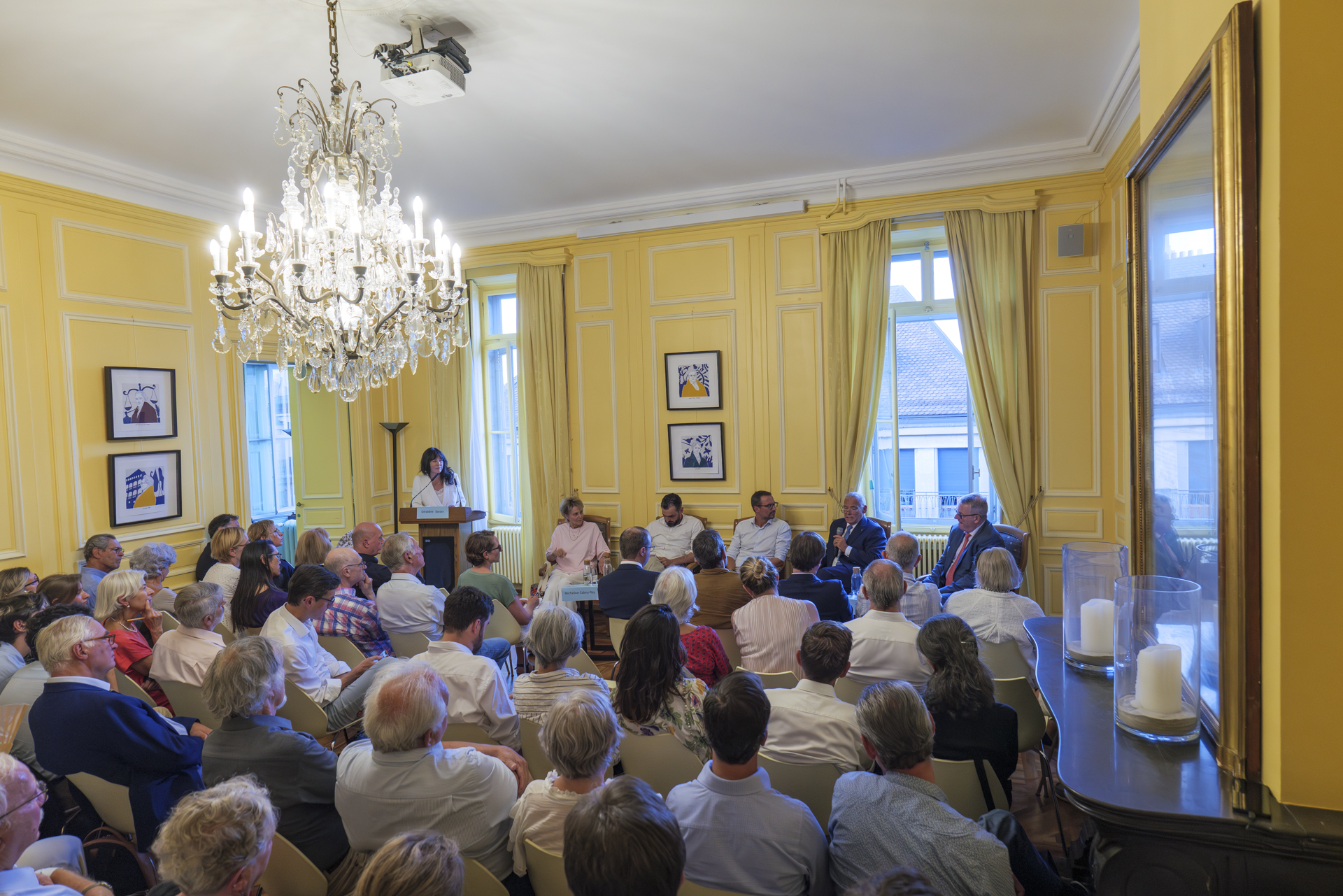
As the 27 September vote on Swiss neutrality approached, Geneva became, for one evening, the stage for a debate in which different visions of what it still means to be neutral today confronted one another. On 7 September, the Geneva Center for Neutrality (GCN) and the Swiss Press Club brought together philosophers, political leaders, diplomats and security experts before a full house at the Société de Lecture.
Opening the evening, Nicolas Ramseier, President of the Geneva Center for Neutrality, recalled the GCN’s mission: to provide a place where opposing positions confront one another rather than ignore one another. For him, neutrality is not a posture of withdrawal, but a capital of trust that is built - and lost - through actions. It belongs to no camp: it was precisely because the issue is divisive that supporters and opponents of the initiative needed to be brought together around the same table.
The debate could have begun with a political confrontation. Martin Chodron de Courcel, Professor of Philosophy and member of the Committee of the Geneva Center for Neutrality, chose instead to take a broader perspective. He invited the audience to return to the essential question: what is neutrality, not as an electoral slogan, but as a historical experience and a moral imperative?
His central idea gave depth to the entire conference: Swiss neutrality is not a passive refusal to choose, but an active form of freedom, responsibility and historical fidelity. It resists the dangerous temptation to divide the world between absolute good and absolute evil, in order to preserve a space for dialogue and peace. Neutrality, he explained, is neither an immutable formula nor a finished doctrine. It is “an idea, an intention” that becomes more clearly defined through history and difficult decisions. Switzerland did not receive it as something definitively constituted: it shaped it, tested it and, at times, reinvented it.
“On 27 September, it will be impossible to remain neutral”
Géraldine Savary, Director of the Swiss Press Club and moderator of the evening, then brought the discussion back to the immediate political choice: “On 27 September, it will be impossible to remain neutral. The Swiss people will have to say yes or no.”
On the one hand, supporters of the initiative believe that Switzerland has gradually weakened its neutrality, particularly by adopting European sanctions against Russia. They want to enshrine in the Constitution a permanent and armed neutrality that would, in principle, exclude sanctions not decided by the United Nations.
On the other hand, opponents consider neutrality to be sufficiently protected already and believe that its implementation must retain the ability to adapt in the face of violations of international law. Very quickly, the debate revealed that everyone was defending neutrality - but not the same neutrality.
Samuel Sommaruga: Saving two centuries of credibility
A Geneva physician and co-founder of the Comité pour la Genève internationale et sa neutralité, Samuel Sommaruga, the only supporter of the initiative on the panel, humorously presented himself as a David surrounded by “three Goliaths.” His commitment to the initiative, he stressed, goes beyond party lines.
His main argument concerned international perception. Neutrality does not exist only in legal texts: it must be recognised by others. Yet, according to him, several foreign diplomats no longer consider Switzerland truly neutral since it adopted sanctions against Russia.
In his view, the country risks losing its most precious asset: “200 years of credibility, of accumulated neutrality.”
Sommaruga focused his criticism particularly on sanctions, which he described as a form of political alignment and, at times, as a weapon of war. They rarely affect leaders, he argued, but hit civilian populations hard, sometimes strengthen the regimes they target, and close the channels necessary for negotiation.
His warning was also economic and symbolic. Geneva in the field of diplomacy, Lausanne in international sport, and Switzerland in the field of good offices all benefit from an advantage that neither money nor power can buy: a reputation patiently built over time. A rejection of the initiative, he warned, could be presented abroad as the Swiss people renouncing neutrality.
Vincent Maître: Not turning neutrality into isolation
Geneva National Councillor Vincent Maître countered this view with a legal interpretation. Military neutrality, he recalled, is defined by the Hague Conventions of 1907: among other things, it prohibits a neutral state from participating directly or indirectly in an armed conflict or from placing its territory at the disposal of a belligerent.
In his view, Switzerland has not violated these obligations. The initiative would therefore conflate the law of neutrality with neutrality policy, which is far more flexible and evolving.
“Neutrality cannot be decreed unilaterally. Neutrality exists only when other countries recognise it,” he stressed.
Enshrining a specifically Swiss definition in the Constitution would therefore not be sufficient to give it international effect. Nor should neutrality become a wall separating Switzerland from its European environment.
Maître also defended Switzerland’s adoption of sanctions against Russia. Continuing to trade in Russian oil and raw materials as if the war did not exist would, in his view, make Switzerland an indirect source of financing for the Russian war effort.
Micheline Calmy-Rey: Not merely serving the menu, but helping to create It
Former Federal Councillor and former President of the Swiss Confederation Micheline Calmy-Rey placed the renunciation of force at the heart of neutrality: “For me, it is a moral imperative.”
She nevertheless drew a crucial distinction: it is not neutrality itself that is active, but the policy pursued by the neutral state. Switzerland, she explained, should not content itself with offering a room, a table and diplomatic services. “We stop simply playing the role of the sommelier and take part in creating the menu.”
Such a policy requires speaking with those to whom others no longer speak, proposing solutions and mobilising diplomatic resources. Calmy-Rey recalled Switzerland’s role in the Iranian nuclear dossier, in Colombia, and between Turkey and Armenia.
Regarding the initiative, her position was more nuanced than a simple yes or no. According to her, the text would probably not radically change current practice: it maintains UN sanctions and leaves the Federal Council room for manoeuvre to prevent their circumvention.
The real issue, she argued, would be political. “If this initiative scores too well, you will have the spirit of the UDC blowing over Switzerland’s neutrality policy,” she warned. Conversely, however, a massive rejection could strengthen those who want to bring Switzerland closer to the European Union and NATO. “It is a real dilemma… It is a political vote, not a legal vote.”
Jean-Philippe Gaudin: Neutrality as access to the real world
The intervention of Jean-Philippe Gaudin, former Director of the Swiss Federal Intelligence Service, gave the debate a very concrete dimension. “Switzerland is independent, sovereign, neutral, and its neutrality is armed. Full stop,” he stated from the outset.
For a small country, he explained, neutrality constitutes a force multiplier. It has enabled Switzerland to maintain contacts with intelligence services from across the spectrum, including those of authoritarian states, to organise discreet meetings and even to facilitate prisoner exchanges.
Gaudin nevertheless expressed scepticism about the effectiveness of sanctions. Regimes anticipate them, circumvent them and transfer their cost onto their populations. Sanctions can also produce a “boomerang effect” on the economies imposing them and, instead of shortening wars, contribute to prolonging them.
His position, however, was by no means isolationist. Switzerland, he argued, cannot ensure its defence alone. It must cooperate, train with foreign armed forces and strengthen its capabilities in the face of cyberattacks, disinformation and hybrid threats.
Jean-Pierre Pasquier: Neutrality is an instrument, not an end in itself
Jean-Pierre Pasquier, member of the Geneva Grand Council and Mayor of the City of Onex, defended another essential distinction: good offices are not the monopoly of neutral states. Pakistan and the United Arab Emirates have also played roles in international mediation.
Geneva’s strength derives from a broader combination of factors: its history, its discretion, its diplomatic expertise, its capacity to host international actors and its exceptional concentration of international organisations.
On the vote itself, Pasquier summed up the issue clearly: “On 27 September, we are not voting on neutrality; we are voting on how to express it.” Neutrality should therefore not become a self-contained objective, but should remain an instrument serving the country’s security, diplomacy and interests.
A policy of prudence, never a policy of absence
Historian Dominique Dirlewanger concluded the debate by distinguishing three dimensions that are often confused: the declaration of neutrality in wartime, neutrality policy, and neutrality as an element of Swiss identity. History, he recalled, knows no immutable neutrality.
Since 1815, neutrality has been renegotiated, adapted and applied “with varying geometry.” Dirlewanger quoted Max Petitpierre, then head of Swiss diplomacy, who warned as early as 1947: “Neutrality must inspire us to prudence. It must not lead us to abstention and condemn us to passivity.” Neutrality is a demanding discipline: defending one’s sovereignty without withdrawing from the world, cooperating without aligning, and speaking to everyone without serving the interests of each.
On 27 September, the Swiss will decide not only on the place of neutrality in their Constitution, but on what they want to make of it in a fragmented world: a refuge, an instrument of mediation, a conscience, a bridge - or all of these at once.