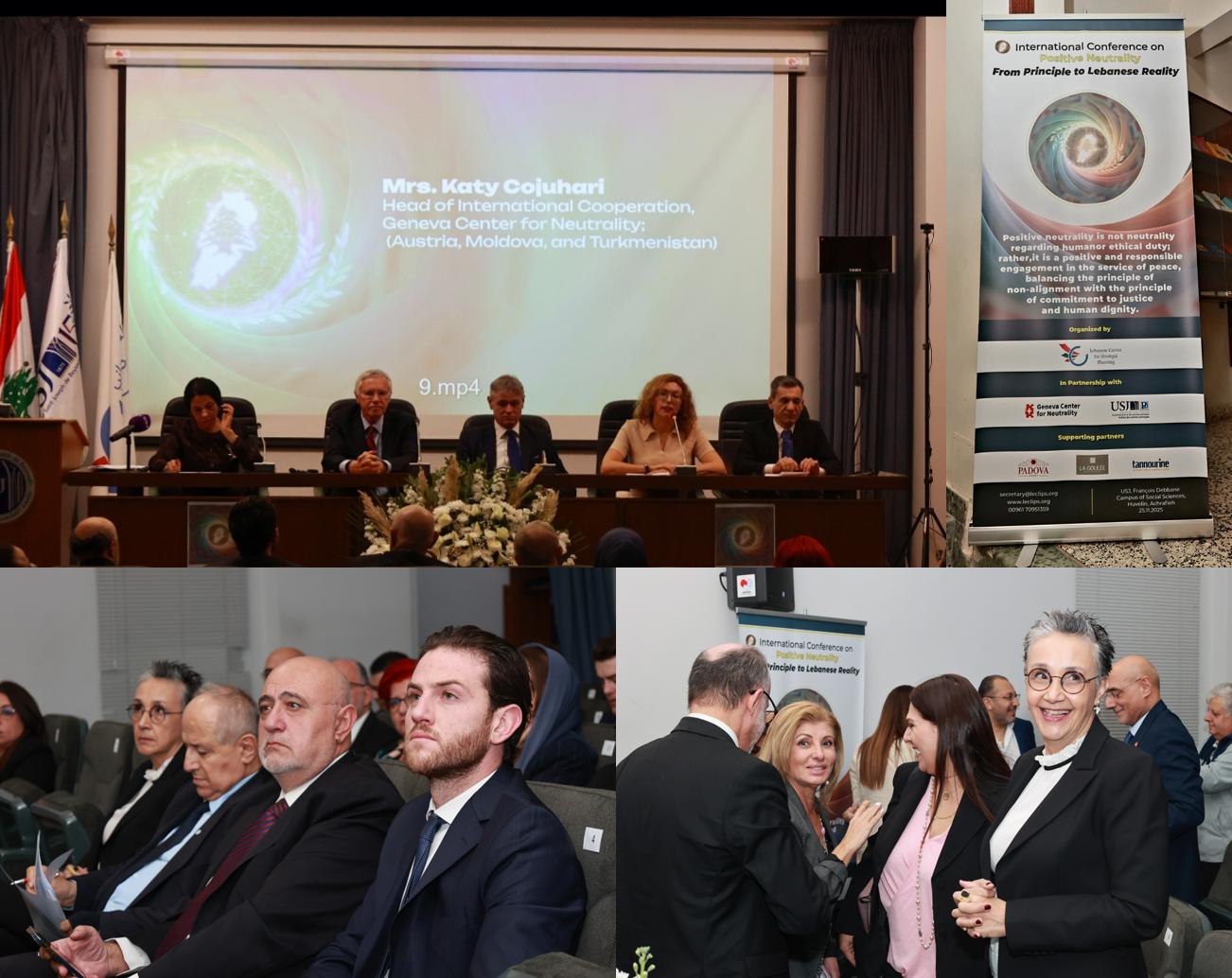
The international conference on “Positive Neutrality: from Principle to Lebanese Reality” on November 25 in Saint Joseph University in Beirut brought together experts, diplomats, and national stakeholders to examine how a framework of positive neutrality can strengthen Lebanon’s stability, sovereignty, and regional positioning. The conference was initiated and organized by the Lebanese Centre for Strategic Planning in partnership with the Geneva Center for Neutrality and Saint Joseph University.
During the panel “International experience in Positive Neutrality: Lessons from Neutral Countries”, Amb. François Barras, who served as Ambassador of Switzerland in Lebanon two terms, in his speech talked about neutrality as the core of Swiss identity. Linguistic and religious pluralism, liberal values and a strong culture of compromise, direct democracy and neutrality preserved Swiss unity during moments of deep cultural division, including World War I when linguistic regions sympathized with Germany and France. It remains a key stabilizer of national cohesion. Inspired by Henri Dunant, founder of the Red Cross, Switzerland developed active neutrality: hosting international organizations, facilitating dialogue and mediation, delivering humanitarian aid. Neutrality here becomes a constructive contribution to global peace. Lebanon, like Switzerland, is diverse and often polarized. The Swiss model offers valuable lessons: neutrality can protect internal unity and de-escalate of internal political tensions. It can protect from regional conflicts and alignments and help Lebanon to shift toward active neutrality - serving as a regional hub for dialogue, humanitarian action, and diplomacy. It can return to Lebanon its historical role as a cultural, diplomatic, and economic bridge.
Amb. Jean-Daniel Ruch, who served as an Ambassador of Switzerland in Turkey, Israel and Serbia, former Special Representative of Switzerland in the Middle East, co-founder of the Geneva Center for Neutrality, in his speech underlined that in today’s geopolitical landscape, the world seems to be returning to imperial-style competition, where major powers - China, Russia, and the United States - struggle for territories, resources, markets, and control of trade corridors. Until these giants potentially agree on “a new set of rules,” the remaining 190 UN Member States must decide how to navigate increasing pressure to enter one power’s sphere of influence. This dilemma is particularly severe for countries situated in grey zones between competing blocs. The most tragic current example is Ukraine, where the rivalry between the West and Russia has resulted in the destruction of the lives of hundreds of thousands, if not millions of mostly young men.
He identified three types of neutral states:
Buffer States: created to stand between rival powers. In 1815, states from the North Sea to the Mediterranean, including Switzerland, were meant to separate France from the German powers. This system collapsed when Nazi Germany invaded the Netherlands and Belgium in 1940, showing that neutrality works only when the neutral state is militarily strong. Hence Switzerland’s credible armed force.
Neutrality for Domestic Cohesions: states like Costa Rica and Turkmenistan declare neutrality to avoid regional conflicts. This matters especially in diverse societies. Switzerland and Lebanon, both composed of communities linked to neighboring powers, use neutrality as “insulation” from external interference. The failure of the former Yugoslavia illustrates what happens when internal cohesion is too weak.
Variable-Geometry Neutrality: states that avoid taking sides in specific conflicts. Turkey attempted mediation between Russia and Ukraine in March 2022. Middle Eastern countries: Qatar, Saudi Arabia, Egypt, and the UAE, also mediate some conflicts while participating in others (e.g., Yemen, Sudan, Congo).
“Despite all their differences, the various types of neutral States share a common objective: preserving their independence and sovereignty from the malign actions of big powers. This is at the core of the Charter of the United Nations, which sets as a paramount principle of international peace the sovereign equality of all States... What about a global role for neutrality? Indian thinker Sundeep Waslekar advocates the creation of a Council of Neutral States within the United Nations. Its main role would be to mediate conflicts between major powers. One might add that such a Council would be instrumental in addressing key challenges for the survival of mankind", - Amb. Jean-Daniel Ruch said, emphasizing that for Lebanon, where communities often have ties to regional or international actors, neutrality would reduce foreign manipulation of internal divisions, strengthen national cohesion, provide a framework where the desire to live together outweighs external alignments.
Katy Cojuhari, the Head of the International Cooperation at the Geneva Center for Neutrality shared experience of Austria, Moldova and Turkmenistan, who are neutral by Constitution, but this triad has different models of neutrality – from the "active" European model (Austria), to the institutionally recognized UN model (Turkmenistan), and the "compromise" model berween West and Russia in the context of the unresolved Transnistrian conflict in Moldova.
How did Austria turn this status into an advantage? It has become a diplomatic hub. Vienna is a world-class venue: the UN Office, IAEA, the OSCE, OPEC, etc. This brings prestige, employment, a tax base, and soft power. Having joined the EU, Austria maintained its neutrality and made it part of its identity. Today 75% of the Austrian population supports the country remaining neutral, but "defensible with military force." Will Austria maintain its security model without military alliances and will it continue to promote ideas of humanitarian neutrality and conflict mediation, the coming years will show.
The 1994 Constitution enshrined permanent neutrality of Moldova. However, due to the Transnistrian conflict, Russian troops remain in the country, complicating the implementation of neutrality. The declaration of neutrality was linked to domestic political consensus, ensuring Moldova's security within the existing European security architecture. This was also a positive factor for Moldova in the wake of the Transnistrian conflict. Since 2022, Moldova's European integration has accelerated. However, the current government in Moldova sees neutrality as a constitutional obstacle or « anchor » on the path to EU membership. Which is not the case, and Austia example proves it. According to polls conducted in 2025, 78% consider neutrality to be in Moldova's national interest, capable of serving as an "umbrella of stability" and guaranteeing peace. Moldova's experience could potentially help understand how small states can use neutrality to reduce geopolitical pressure while simultaneously reducing domestic political polarization.
In the wake of the upheavals associated with the collapse of the Soviet Union, Turkmenistan adopted a model known as positive neutrality, having secured this status in the Constitution. In 1995, the UN General Assembly recognized and supported Turkmenistan’s permanent neutrality. Thanks to its neutral status, Ashgabat maintains equal relations with all countries, cooperating with China, Russia, the US, the EU, and Iran without taking sides. This allows it to diversify its foreign policy and economic partnerships, benefiting from competition between major powers. At the same time, its neutral status increases investor and partner confidence in energy transportation and helps it act as a “bridge” between Asia and Europe along energy and transport routes. Turkmenistan’s internationalized neutrality through the UN, supported by economic diplomacy, has become an international brand of predictability.
"Thus, neutrality has been and can remain an instrument for strengthening sovereignty and stability if it is backed by domestic resilience and active diplomacy. The experiences of Austria, Moldova, and Turkmenistan show that maintaining neutrality can yield political, economic, and diplomatic benefits », - Katy Cojuhari said.
Dr. Roberto Zamora shared an expereience of Costa Rica, where Permanent Neutrality is a foreign policy approach aimed at constructing and maintaining peace, not just during wartime. Costa Rica's neutrality declaration in 1983 was a response to the pressure of the Cold War in Central America, allowing the country to decline the U.S. request to use its territory for military purposes. Neutrality also has allowed Costa Rica to play a positive role as a broker of peace in the region, facilitating the Esquipulas Peace Agreements in 1987.
Costa Rica is one of the rare countries, which does not have army. It's demilitarization since 1949 has enabled it to redirect resources to social development, leading to high human development indicators. Neutrality also positioned Costa Rica a country as a safe, stable, and attractive destination for foreign investment and economic development. “Costa Rica's model of neutrality, combined with demilitarization and investment in social development, has proven successful and can serve as an example for other countries. Neutrality can be an effective strategy for small and middle-income countries to navigate complex geopolitical landscapes and assert their sovereignty”, - Dr. Roberto Zamora is convinced.
During the following three panels of the international conference on “Positive Neutrality: from Principle to Lebanese Reality”, representatives of the main political parties of Lebanon discusses the possibility of neutrality for Lebanon, which in the current context looks difficult to achieve, but in coming years a possible constructive solution for the country’s internal and external peace.
Dr. Wissam Maalouf, the President of the Lebanese Centre for Strategic Planning, at the end of the conference announced an establishment of the Commission on Positive Neutrality with two primary objectives: to launch a national debate that engages political actors, civil society, and institutions in an informed and inclusive dialogue on the concept of positive neutrality; and to prepare a draft of proposed constitutional amendments that would anchor this principle within Lebanon’s institutional and legal architecture. Through rigorous consultation and consensus-building, the Commission aims to provide a clear roadmap that can support Parliament in considering a modern, stabilizing, and forward-looking framework for Lebanon’s future.