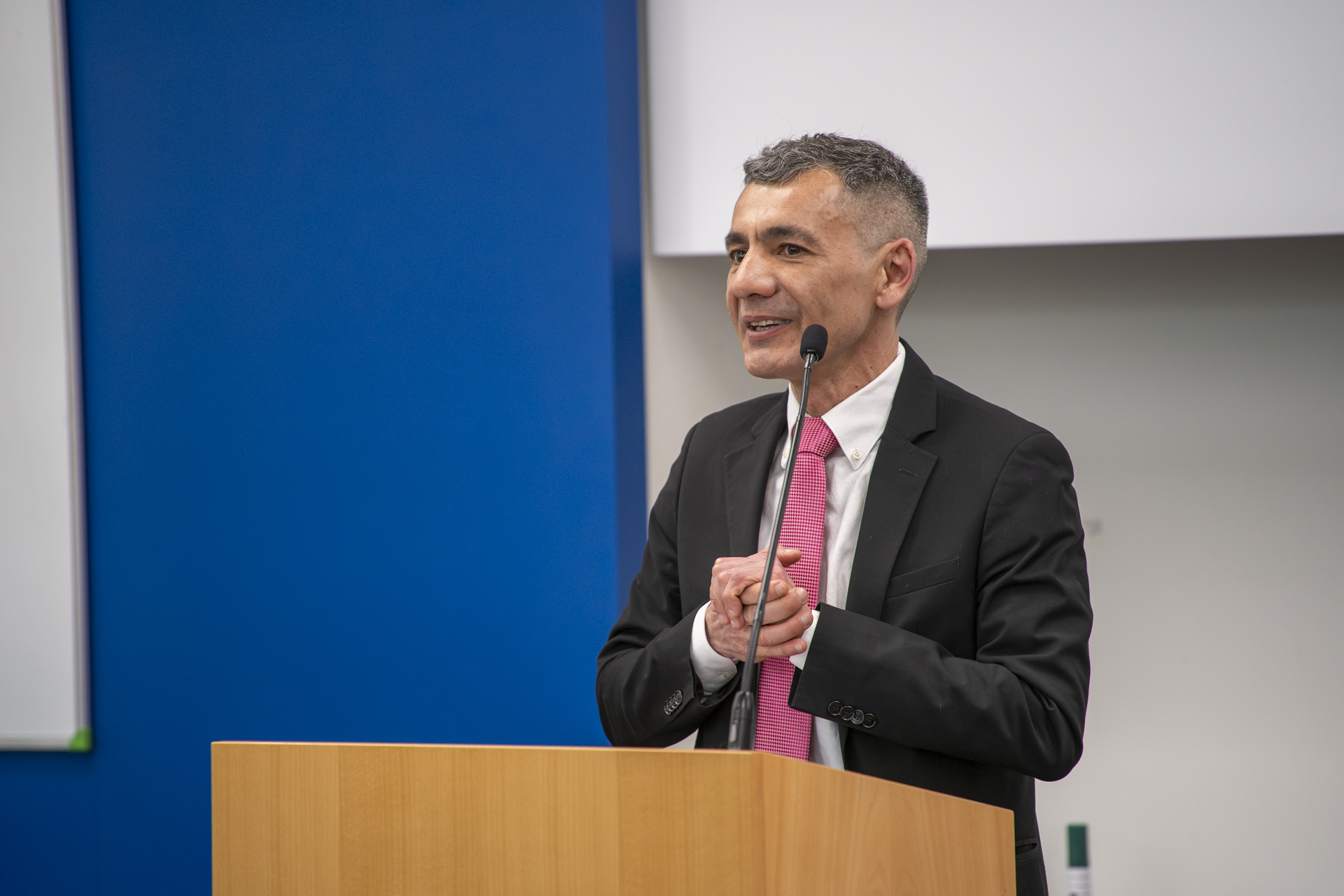
During the International High-Level Conference “Neutrality from Different Perspectives: Between Tradition and Pragmatism,” organized by the Geneva Center for Neutrality and the Institute for Global Negotiation on May 6 in Bern, Dr. Roberto Zamora - Costa Rican political scientist, former Ambassador in South Corea, international law scholar, and researcher at the University of Helsinki, delivered a thought-provoking keynote on the future of permanent neutrality in an increasingly polarized world.
Representing Costa Rica’s unique diplomatic tradition, Dr. Zamora presented a bold and intellectually challenging speech examining neutrality not as a relic of the past, but as one of the most underappreciated instruments for peace, mediation, and international stability. Drawing from legal history, contemporary geopolitical crises, and Costa Rica’s own exceptional experience as the world’s only demilitarized permanently neutral state, he offered a powerful argument for why neutrality may become one of the defining strategic choices of the 21st century.
“Permanent neutrality is perhaps the most underrated and sidelined institution in international law and politics. Today, I will provide an overview of the different models of permanent neutrality as currently practiced. But first, some remarks about its importance throughout history.
The potential of permanent neutrality as a powerful tool for international peace and stability has been undermined by the fact that war has been more influential than peace in shaping international relations and the contemporary world order. From the Middle Ages until the creation of the United Nations, neutrality was understood as an institution at the service of belligerents, rather than as a voluntary, sovereign legal framework enabling peaceful coexistence. While neutrality in times of war was codified at the 1907 Hague Peace Conferences, permanent neutrality remains uncodified and doctrinally underdeveloped, overshadowing its broader role as a peace-building mechanism.
Yet history shows that permanent neutrality played a vital role in the pacification of Europe, both as a non-escalatory policy and as a practical tool through non-involvement and buffer zones. During the 18th and 19th centuries, Switzerland, Belgium, and Luxembourg, among others, helped prevent or contain conflicts by creating cushion areas between antagonistic powers.
During the UN's creation process, neutrality faced heavy attacks from those promoting a bloc-dominated world order. Hegemonic and war-minded states claimed incompatibility and openly declared neutrality dead. Despite these attacks, neutrality survived, and during the Cold War it rose as an underappreciated hero — a corridor of neutral states in Central and Eastern Europe provided the necessary distance between the blocs, preventing escalation and possibly armed conflict.
In the UN era, neutrality has seen a resurgence in both the number of neutral states and in evolving practices. Through all these challenges, consensus has emerged regarding the main duties of permanently neutral states: total abstention from participation in conflicts except through good offices and mediation, non-participation in military alliances, absolute impartiality, and the prohibitions on supporting belligerents by any means, hosting military bases, or allowing troop transit with hostile intent. Regarding neutral rights, the most significant are the inviolability of neutral territory and freedom of commerce with all belligerents, unless the UN Security Council has imposed sanctions. It must be noted that unilateral sanctions imposed by states or international organizations lack a legal basis under international law; consequently, neutral states shall therefore refrain from executing them.
As doctrine highlights, a key component of neutrality is the friendliness of neutrals. Beyond avoiding enmities, neutral states shall actively foster friendly relations with all. This is their greatest strategic strength. A neutral state maintains friendship regardless of circumstances, without judging in terms of just war. This is precisely what legitimizes permanent neutrals as pacifiers and mediators when the institutions created for that purpose become dysfunctional. Only a state perceived as friendly and impartial by all parties gains the legitimacy necessary for successful intervention. With this in mind, five models of permanent neutrality can be identified: by treaty, as a foreign policy carrying, as a domestic obligation, the particular case of Switzerland, and the exceptional case of Costa Rica.
Malta is the only State that maintains neutrality by treaty. If we understand neutrality as an obligation ad orbi, this model is not recommended. Treaties only apply inter partes; as such, seeking universal neutrality through this mechanism is impractical. Moreover, this model subordinates the adoption of neutrality to the will of the counterparts, deterring the erection of neutrality as an exercise of sovereignty and independence.
As a foreign policy, countries like Ireland, Singapore, and Oman exemplify this model. These countries are not bound to maintain their neutrality in any way. Through consistent adherence to this policy, Ireland has become an important participant in peacekeeping missions. At the same time, Singapore and Oman have served as hosts of sensitive international conferences or as effective negotiators. None of them hosts foreign military bases; however, they have agreements that allow foreign military to be present, undermining their neutral status. The case of Shannon Airport in Ireland has sparked multiple debates about Irish neutrality. In the case of Oman, it has allowed it to remain attack-free in the current US-Israeli illegal invasion of Iran.
As a domestic obligation, countries such as Austria, Moldova, Turkmenistan, and Cambodia have incorporated neutrality clauses into their constitutions, interlinking law and foreign policy. In the case of Austria, and due to the political circumstances of the time, its neutrality was crucial to post-World War II pacification and nowadays hosts several UN bodies, including the IAEA and the Preparatory Commission for the Comprehensive Nuclear-Test-Ban Treaty; however, the political events of the last years have put Austria’s neutrality in question. Moldova has participated in UN peacekeeping missions but has yet to take a more active role in pacifying efforts. The Turkmeni case is peculiar, as it sought recognition before the UN General Assembly prior to adopting neutrality in its constitution. Moreover, Turkmenistan is the only State that has pushed for greater international recognition of neutrality in the modern world by promoting the 2017 UN General Assembly resolution on the declaration of the International Day of Neutrality, which highlighted the importance of neutral States and buried the debate about its validity within the UN system. These States have yet to actively engage in practicing positive neutrality. Despite this, the adoption of a constitutional obligation provides robustness and certainty to their stance in case of foreign wars. This model is somehow paradoxical, for neutrality is, by its nature, a stance adopted towards the international community; in other words, a State doesn’t adopt neutrality towards itself.
Cambodia’s neutrality clause is consequential to the 1991 Peace Agreements that ended its war. Although an active peacekeeping participant, it has practiced a “Friend to all, Enemy to none” policy, but its military ambivalence has called its neutrality into doubt.
The case of Switzerland is remarkable. It is the longest-standing neutral State in the world, and it has consistently practiced positive neutrality, cementing its reputation as a legitimate, impartial peace-broker. Despite this history and reputation, some ‘yellow flags’ must be raised. Although in its 1993 White Paper on Neutrality, the Swiss highlighted its recognition by international law in the context of the 1815 European pacification Treaties to which the country acceded, the country denies any derived international obligation, claiming that neutrality can be unilaterally withdrawn at any time, which seems to contradict its sharp observation that neutrality’s strength relies on the predictability of its conduct. The other yellow flag to be raised relates to the selective application of unilateral sanctions, not only because these are illegal under international law, but also because, in the context of hybrid warfare, they can be perceived as a hostile act in breach of neutrality, while weakening the credibility of the institution.
Finally, Costa Rica is the only country to have adopted neutrality as an unilateral obligation of international law. Neutral since its independence in 1821, it wasn’t until 1983, in the context of the Cold War’s US contra wars in Nicaragua, that Costa Rica issued its neutrality declaration, as a mechanism to remain out of the bloc dispute and non-escalate the conflict. Its reputation as a peaceful and neutral nation enabled it to broker the Central American peace process in the late 1980s. Its self-imposed international obligation towards neutrality allowed for a unique situation in world history, as in 2003, while a law student, I challenged the Supreme Court the support given to the US-UK-led coalition that illegally invaded Iraq. The Supreme Court found the support to be contrary to its international obligation, ordering the withdrawal from such a coalition. Also, in 1948 Costa Rica demilitarized itself, becoming the only demilitarized neutral State, combining realist pragmatism with a full-fledged bona fide reliance on the rule-based order. As a poor country, diverting funds from militarism to healthcare and education proved the wisest decision for its human development indices. The country’s security policy is based on the belief that having no enemies is safer than militarism.
Of all the models described, and despite the little attention it has received, the Costa Rican model seems the most robust in providing the stability and predictability that Switzerland highlights as the cornerstone of neutrality. The effectiveness of neutrality relies exclusively on the neutral's credibility in the eyes of the contenders. This is why it is fundamental that neutral States adhere to it stoically, without circumstantial flexibilizations, something the Swiss could pay attention to. Without a unified legal framework and practice, any neutral's actions can affect the institution as a whole.
In the resurgence of a bipolar world, opting for the escalatory bloc dynamics is the worst scenario; we already experienced that during the Cold War. Neutral States should take the opportunity to join together and strive for international codification, providing uniformity and security to the regime, but, most importantly, creating a third option at this delicate crossroads, where international peace is in peril. Neutrality can be the most valuable asset in maintaining world peace. But for that to happen, neutral states must act together - and act now.