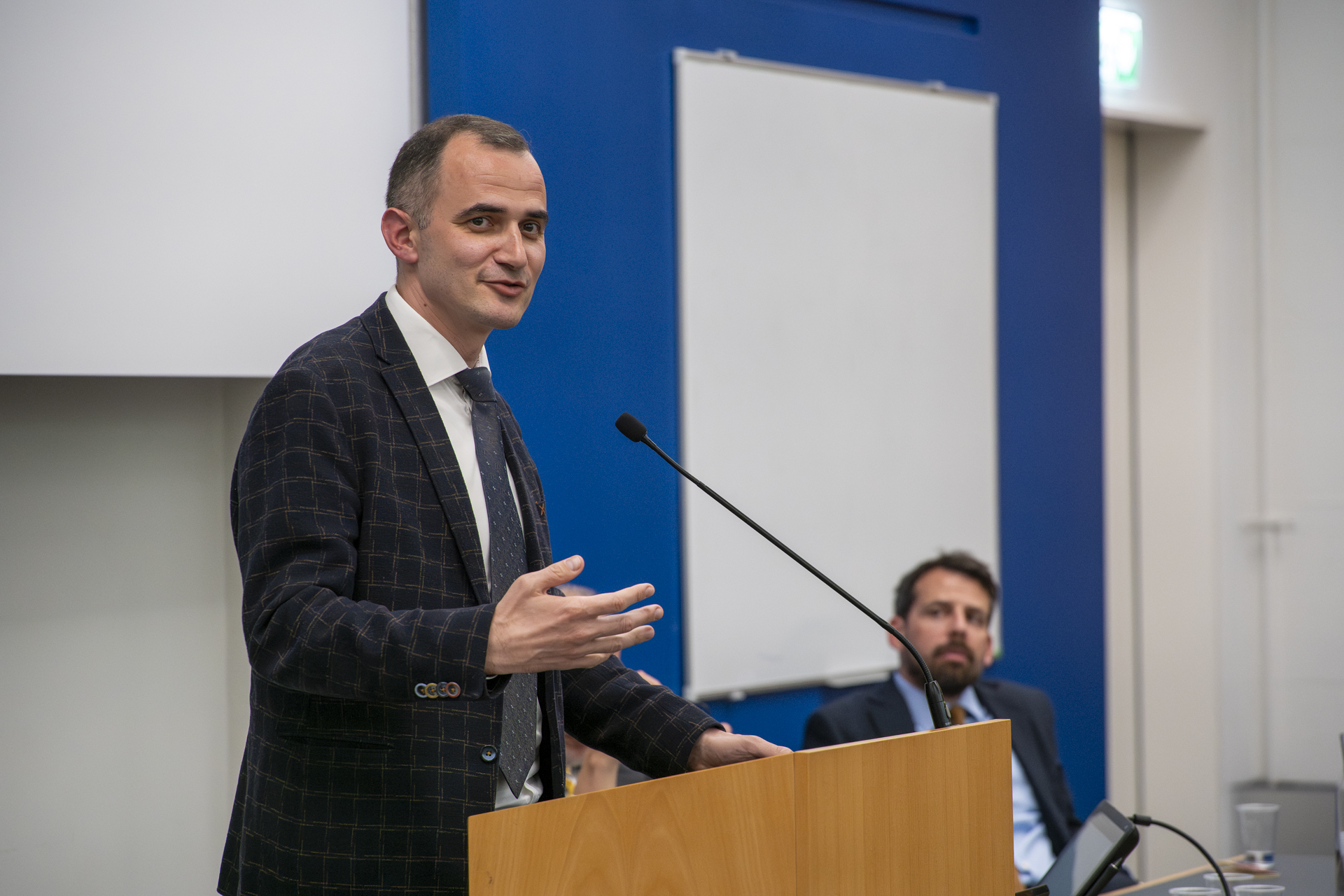
At the international high-level conference “Neutrality from Different Perspectives: Between Tradition and Pragmatism,” held on 6 May 2026 at the World Trade Institute (University of Bern), diplomats, government officials, and scholars from across Europe and beyond gathered to discuss how neutrality is evolving in an increasingly polarized international system. The event was organized by the Geneva Center for Neutrality together with the Institute for Global Negotiation. Among the keynote speakers and panelists were Dr. Joachim Adler (Switzerland), Günther Barnet (Austria), H.E. Shota Getsadze (Georgia), Dr. Roberto Zamora (Costa Rica), Dr. Gergely Varga (Hungary), and Professor Nicolai Tveatcov from Moldova.
During the panel “Neutrality as Pragmatism and Strategy,” Professor Nicolai Tveatcov - a Moldovan political scientist and scholar specializing in geopolitics, security, and national identity in the post-Soviet space, delivered an in-depth presentation on the meaning of neutrality for Moldova in today’s geopolitical environment. Drawing on constitutional history, public opinion, regional security dynamics, and Moldova’s European aspirations, he argued that for Moldova, neutrality is not a sign of weakness or indecision, but rather a sovereign strategic choice aimed at minimizing risks, preserving internal stability, and maintaining strategic autonomy. Below we present the main theses of his speech, published on a Moldovan news website: https://noi.md/md/analitica/nicolai-tveatcov-neutralitatea-moldovei-o-alegere-in-favoarea-riscului-minim
"It is well known that Moldova today is located at a geopolitical crossroads, situated between the European Union and a region affected by ongoing military confrontation. Under such conditions, the margin for error in foreign policy and security policy is extremely limited. That is why today the following question arises: “How can Moldova preserve stability, sovereignty, and strategic autonomy under conditions of growing external pressure?” My answer lies in a concept that is often mentioned, but sometimes misunderstood. I mean constitutional neutrality. Why is Moldova’s neutrality so little known? Allow me to begin with a paradox.
Moldova’s neutrality is clearly written into our Constitution. And yet, in international discussions, it is often perceived in two ways: as irrelevant or as imposed by external actors, especially Russia. But both interpretations are misleading, because Moldova began discussing this issue in 1990, by adopting the Declaration of Sovereignty, in which our country was for the first time declared a “demilitarized zone.” Here I must emphasize - this was even before the collapse of the USSR. In 1994, Moldova incorporated neutrality into the Constitution, receiving broad public support and territorial fragmentation after the military phase of the Transnistrian conflict. This compels us to insist that the constitutional status was not imposed from outside, but was a clear sovereign decision of the Moldovan people and the political class during that period. I must emphasize that this was a decision taken by a small country with limited military potential, facing unresolved territorial problems. In fact, neutrality was and remains a risk-management strategy.
There is another widespread assumption, another paradox, that neutrality somehow contradicts European integration. But this is not supported by empirical data. Neutrality is a security doctrine, not a civilizational choice. It does not prevent a country from integrating into the European Union economically, politically, or legally. We have clear examples of this in Europe. Thus, the problem here lies rather in misinterpretation. For many years, according to numerous opinion polls, from 60% to 70% of Moldovan citizens have supported preserving neutrality, regardless of which political party is in power. Thus, it is obvious that this was not a temporary fluctuation supported by a majority. It still reflects a broader public consensus in Moldova.
Moreover, we can say that this functions as a kind of social contract between the people and the authorities regarding security and the country’s place in Europe and in the world. Ignoring this consensus would intensify internal divisions, and under current regional conditions, this would be a serious mistake that could undermine or even endanger Moldova’s European path. That is why the current authorities are asking themselves a key question: to what extent does neutrality protect Moldova? To answer this question, we need to be realistic about the threats that Moldova actually faces. At the moment, Moldova is not facing a scenario of immediate invasion with conventional weapons. But it should be noted that the current Moldovan authorities do not understand neutrality as passive non-alignment. It is increasingly presented as active resistance to Russia, which includes the unresolved conflict in Transnistria, external geopolitical pressure, energy vulnerability, and informational “war.”
For Moldova, neutrality provides diplomatic flexibility, allows maintaining dialogue formats, and avoids framing the conflict in purely geopolitical terms. Thus, neutrality does not solve the Transnistrian problem, but it helps prevent the deterioration of the situation. Yes, the Republic of Moldova is not isolated from international cooperation. For example, Antony Blinken, during his visit to Chisinau in March 2022, emphasized that the United States supports Moldova’s neutrality, sovereignty, and resilience, including through “non-lethal assistance, institutional development, and energy cooperation.” This is important, because neutrality under such conditions does not function as a traditional military shield. It functions as a stabilizing mechanism, first of all in relation to the Transnistrian factor.
What do I mean? For more than 30 years, approximately 1,500 Russian servicemen have been stationed in the Transnistrian region, along with significant ammunition stockpiles. This creates a structural barrier to Moldova’s capabilities. In such a situation, neutrality plays a very important role - it helps reduce the risk of escalation. That is why a rapid change in Moldova’s security position may provoke destabilizing actions - political, economic, or even local security incidents. The problem also lies elsewhere - in transparency. Defense spending in Moldova has doubled in recent years — approximately from 0.4% of GDP to 0.8%. By European standards, this is still a modest indicator, but it reflects a shift toward greater awareness of security risks. At the political level, we also see how the ruling party allows for rethinking neutrality, which creates new problems, because if military cooperation becomes too closely connected with alignment, this may undermine public trust both inside the country and beyond its borders. Thus, it is obvious that neutrality can play a stabilizing role or be a vulnerability. Neutrality is stabilizing when it is clearly communicated, supported by society, and consistently applied. And it becomes vulnerable when it is ambiguous, selectively interpreted, or used for narrow political purposes.
In other words, the real risk lies not in neutrality as such, but in the lack of transparency, because this provokes the question of whether Moldova may abandon neutrality. This leads to another important question: can Moldova be forced to abandon neutrality, and what scenario could be negative in this case? Formally, Moldova can do this. But external pressure may intensify, especially in the context of the war between Russia and Ukraine. Moldova may face indirect political pressure, economic challenges, or security challenges. However, abandoning neutrality will not automatically solve these problems. Perhaps neutrality is not ideal, but for Moldova any other scenario is associated with higher risks. First of all, this would most likely deepen internal divisions, since Moldovan society remains divided in its geopolitical preferences. Secondly, this may increase tensions in Transnistria, where any change in Moldova’s geopolitical orientation may be perceived as a direct threat. Thirdly, this may expose Moldova to even greater external pressure without providing sufficient security guarantees.
Conclusion: neutrality is our strategic autonomy. Moldova’s neutrality should be understood as a political instrument for preserving internal stability and manageable external relations. The real challenge lies in how to reconcile this with European integration, institutional development, and economic prosperity. This requires careful balance and, above all, a policy based on national interests. Neutrality is a choice shaped by the geography and history of Switzerland, Austria, Malta, Ireland, and Moldova. The key question is that neutrality can provide greater stability at lower cost".