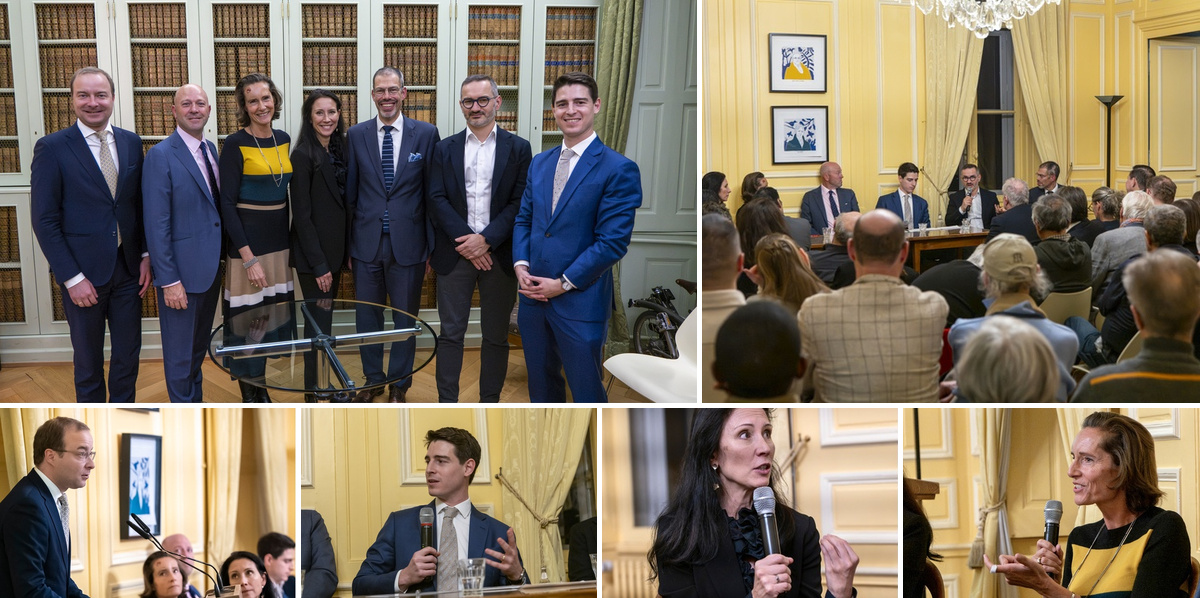
Why do so many Swiss AI start-ups end up funded, and sold, abroad? Academic, financial and diplomatic leaders weighed in at an evening organised by the Geneva Center for Neutrality on 30 October 2026.
Switzerland knows how to produce research; the question on 30 October 2026 was whether it can keep the companies that research creates. At the Société de Lecture in Geneva, the Geneva Center for Neutrality organised "From Lab to Market", an evening with Prof. Anna Fontcuberta i Morral, President of EPFL; Prof. Marilyne Andersen, Director General of GESDA; Prof. Srdjan Čapkun of ETH Zurich; Jay Woods, Chief Global Strategist of Freedom Capital Markets; and Nicholas Niggli, former chair of the WTO pension plan management board. Raimondo Pictet moderated, after an opening keynote by Nicolas Ramseier, Co-founder and President of the Geneva Center for Neutrality.
Who captures the value of Swiss research?
Nicolas Ramseier opened by separating invention, which belongs to knowledge, from innovation, which needs a company to carry an idea to market. That, he suggested, is where Switzerland's shortage may lie. One new Swiss deep tech company in four now works on AI, and EPFL and ETH Zurich counted a record 85 new start-ups and spin-offs last year. Yet when Swiss deep tech companies raise rounds of 15 to 100 million dollars, 82 percent of the capital comes from abroad, against a European average of 60 percent, and in 2024, 30 of the 41 Swiss start-ups that were sold went to foreign buyers. Foreign capital is welcome, he said; the problem begins when value created with public research money grows elsewhere.
"A paper is not a product. A product is not a paying customer. A customer is not a company, and a company is not an economy." — Nicolas Ramseier
Geneva has bridged those steps before: in 1845, the Polish refugee Antoine Norbert de Patek and the French watchmaker Jean Adrien Philippe founded the company that still bears their names, Philippe supplying the invention and Patek the commercial drive.
Capital, computing power, trust: what Switzerland has and lacks
Capital, computing power and trust, Ramseier argued, are the three resources on which that meeting point now depends.
- Capital. Swiss pension funds manage more than 1,200 billion francs; a single percent invested in young Swiss companies would be more than four times the venture capital invested in Switzerland last year.
- Computing power. A single campus in Texas is designed for 1.2 gigawatts, while all commercial data centres in Switzerland offer about 300 megawatts. Sovereignty, he said, means choosing one's dependencies rather than suffering them.
- Trust. Switzerland can offer an open, verifiable model, stable law and EU-recognised data protection, provided rules stay clear and proportionate. Proton chose to host its new AI assistant in Germany last year because of legal uncertainty over proposed surveillance rules.
Neutrality, he added, is not a business model: trust must be maintained, not simply inherited.
Anticipating breakthroughs, launching 40 start-ups
Prof. Marilyne Andersen explained that GESDA does not predict the future. Its Science Breakthrough Radar asks a community of about 2,500 scientists to say what discoveries they expect in five, ten and twenty-five years, so that diplomats, businesses and civil society can prepare. Geneva matters, she said, because science, international organisations and business sit close together.
Prof. Anna Fontcuberta i Morral said around 40 EPFL spin-offs raised some 700 million francs in 2025, comparable to the whole Zurich area. The number rose after EPFL opened entrepreneurship training to undergraduates, and most of its start-ups come from fundamental science, which competitors cannot copy right away. Is the funding enough? "It's not sufficient," she said: a master's student whose Swiss funding arrived two months too late raised four million in the United States instead.
Who will be the first customer?
Jay Woods said Freedom, a group headquartered in Central Asia, is coming to Geneva for its neutrality and stability, and plans to open an exploratory office in January. Nicholas Niggli, who chaired the WTO's pension plan board for about eight years, said institutional investors cannot easily take large risks on young companies, but vehicles exist to bring discipline to illiquidity. His second lever was procurement: states buy goods and services worth 15 to 20 percent of GDP, yet "we are not buying enough from young companies."
Prof. Srdjan Čapkun confirmed that early public clients were crucial for the companies he founded with his students. Switzerland knows how to start companies, he said, but scaling is harder, and a rival with five times the capital is hard to match: "we are probably not five times smarter." Niggli added that two of DeepMind's three co-founders had ties to Switzerland yet were not encouraged to stay; DeepMind ended up in London.
Can trust be built into the technology?
Prof. Fontcuberta i Morral said Apertus 2.0 is expected in the first quarter. It is not a frontier model, but a base for specialised models that lets Swiss companies build products independently while training the students who contribute to it. Prof. Čapkun noted that reaching the frontier would take billions of investment a year in computing, and bet instead on the intersection of AI and cybersecurity: models are powerful but fragile, and must be contained and isolated.
His group works on confidential inference, where a cloud provider processes a query inside protected hardware without seeing the data, and on sovereign smartphones that let a user switch between a familiar operating system and a second one they fully control. The aim, he said, is to live in a mixed trust system while protecting critical data.
"We are never going to solve sovereignty by building everything ourselves." — Prof. Srdjan Čapkun
Geneva AI Summit 2027: honest brokerage or regulation?
Raimondo Pictet turned to the Geneva AI Summit of 2027, for which GESDA is a strategic partner of the Federal Department of Foreign Affairs. Prof. Andersen stressed that GESDA is not the organiser. For her, the summit is a chance for Geneva to be a place where AI is not only discussed but acted upon, with a role built on "honest brokerage" and active neutrality, without stopping innovation.
The panel did not fully agree on regulation. Prof. Čapkun doubted that AI can be regulated, since open models are already out there, and preferred to work on protection. Prof. Fontcuberta i Morral answered that technology depends on human decisions, and that students must learn to anticipate consequences. Niggli called for progressive multilateralisation: coalitions of the willing that move first, rather than waiting for everyone to sign.
A fork in the road
Nicholas Niggli closed by saying that this generation is at a fork in the road, and that what is done in the next five to ten years will be very consequential. The question left open was Nicolas Ramseier's: whether the companies born in Swiss laboratories today will still be growing here a century from now.
Follow the Geneva Center for Neutrality's programme for its next events and publications.