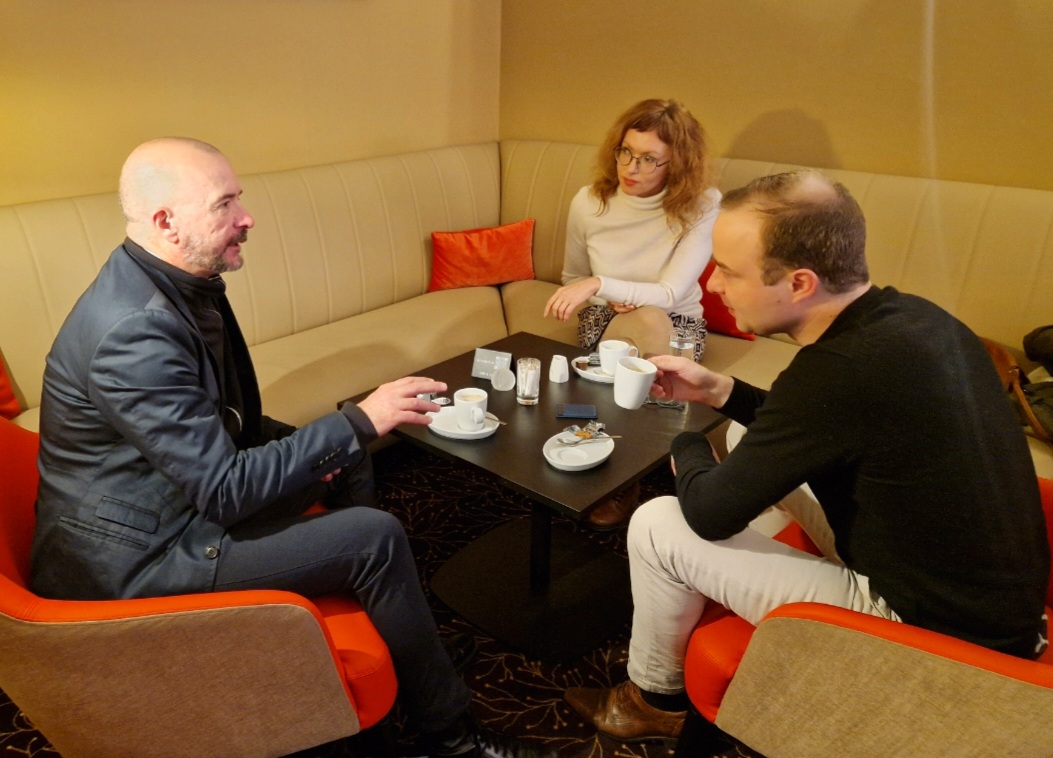
In a charged geopolitical moment marked by increased in wars around the world and deep uncertainty across the Atlantic, the Geneva Center for Neutrality hosted a timely and candid discussion on the future of European security. The conversation brought together Nicolas Ramseier, President of the Geneva Center for Neutrality (GCN); Dr. Flemming Splidsboel Hansen, Senior Researcher at the Danish Institute for International Studies; and Katy Cojuhari, Head of the International Cooperation Department of the GCN, who guided an exchange that revealed both deep disagreements and unexpected convergence.
Swiss neutrality emerged as a central theme. Nicolas Ramseier recalled its legal foundations under the 1907 Hague Convention and underlined that Switzerland’s permanent neutrality has historically implied a careful distance from military alliances, while allowing active contributions to peace, mediation and international stability. “Neutrality was imposed on Switzerland 200 years ago,” he noted, “but over time it became a pragmatic instrument for managing internal diversity and for supporting peace efforts internationally.”
Rather than advocating any fixed model, Nicolas Ramseier stressed the need to rethink European security arrangements in a changing strategic environment. He suggested that future security frameworks should explore flexible mechanisms capable of reducing tensions, increasing transparency and preserving the full sovereignty of states, while avoiding rigid bloc logics that have contributed to instability in the past.
Dr. Flemming Splidsboel Hansen expressed a contrasting view, emphasizing that European states must retain full freedom of action regarding their security choices, including alliance commitments and military deployments. He highlighted Finland’s and Sweden’s recent NATO accession as a response to heightened security concerns in Northern Europe, while cautioning that long term European security cannot rely solely on external actors. He also pointed to internal strains within the transatlantic system and the broader uncertainty linked to shifts in U.S. domestic politics.
Despite their differences, both speakers converged on one key point: Europe urgently needs to strengthen its strategic autonomy. With global power balances evolving rapidly, they argued that Europe must assume greater responsibility for its own defense, energy resilience and technological competitiveness, particularly in emerging fields such as artificial intelligence and quantum technologies. Nicolas Ramseier referred to Switzerland’s tradition of self reliance, while Dr. Flemming Splidsboel Hansen underlined that developments in regions such as the Arctic should serve as a wake up call for European policymakers.
As the discussion concluded, it became clear that Europe is entering a new strategic phase in which traditional distinctions between neutrality and alliance politics are increasingly challenged. The exchange highlighted the importance of continued dialogue and research on how neutral and non aligned states can contribute constructively to European security.
The participants agreed to pursue joint research on neutrality, alliances and European security, focusing on questions such as how neutral states can support stability without formal alliance membership and whether European strategic autonomy is becoming not only desirable but necessary. As Europe navigates its most volatile security environment in decades, Geneva, long associated with dialogue and neutrality, may once again serve as a space for reflection on future security arrangements.