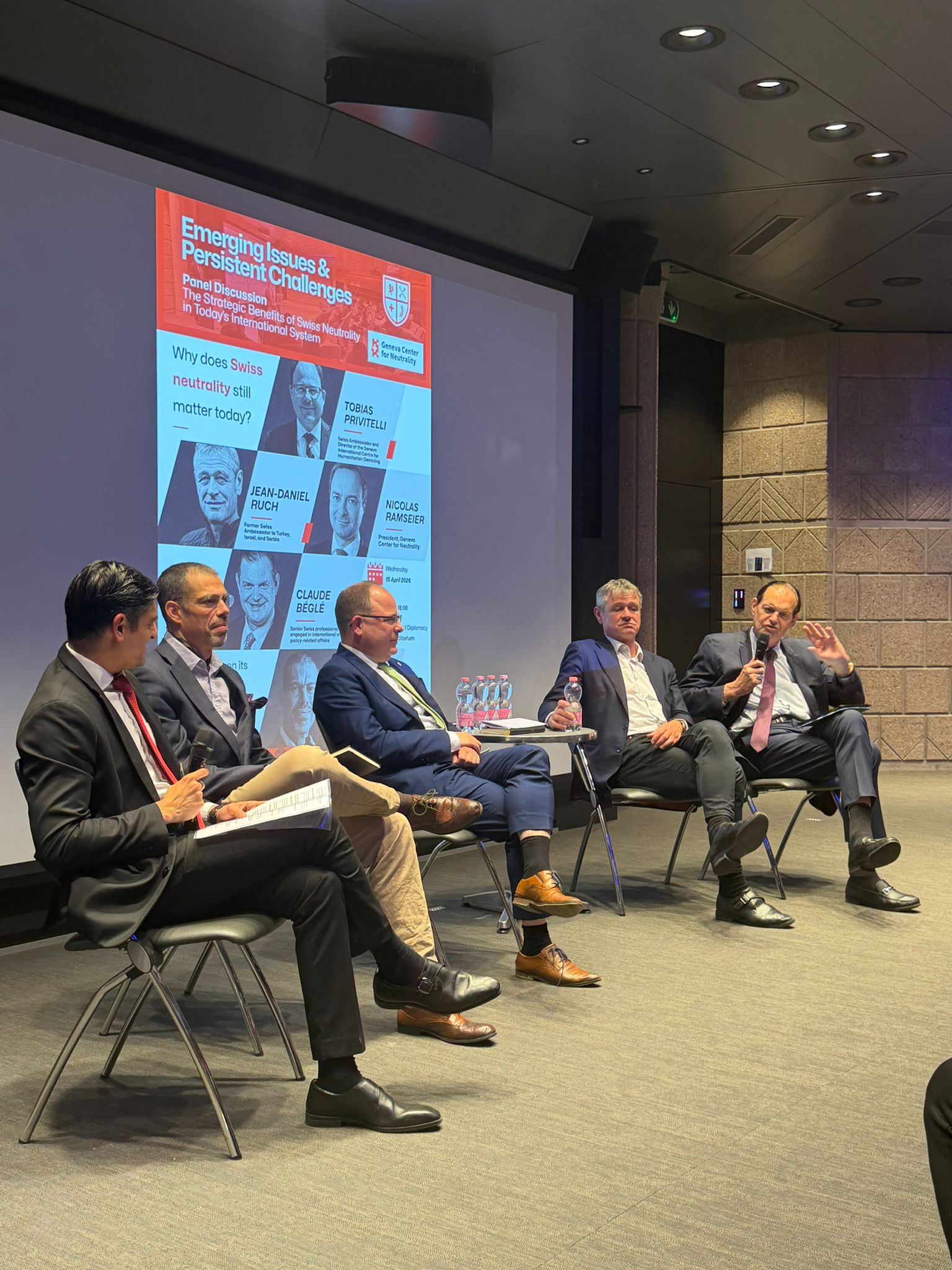
In a period marked by renewed conflict in Europe, intensifying geopolitical competition, and the fragmentation of global systems, Swiss neutrality is undergoing a profound reassessment. No longer viewed solely as a historical legacy, neutrality is increasingly understood as a strategic instrument, one that shapes Switzerland’s diplomatic posture, international credibility, and capacity to act in a divided world.
These themes were explored during a high-level panel hosted by the Geneva School of Diplomacy and International Relations in collaboration with the Geneva Centre for Neutrality. The event took place on April 15, and was opened by a keynote address from Nicolas Ramseier, President of the Geneva Centre for Neutrality. The panel discussion was then moderated by Dr. Rakesh Krishnan and brought together Ambassador Tobias Privitelli, Director of the Geneva International Centre for Humanitarian Demining (GICHD); Jean-Daniel Ruch, former Swiss ambassador and senior diplomat and co-founder of the Geneva Center for Neutrality; Claude Béglé, Swiss entrepreneur and former politician and former member of the Swiss National Council; and Nicolas C. Niggli, Swiss executive and public affairs professional and former elected official in the City of Geneva.
Neutrality as a contested and evolving policy
Neutrality today sits at the center of domestic and international debate. Nicolas Ramseier highlighted the growing uncertainty surrounding its scope, particularly as Switzerland navigates questions related to sanctions, security cooperation, and economic alignment. The absence of a unified political vision reflects a broader structural ambiguity: whether neutrality should remain confined to military non-alignment or extend into political, economic, and digital domains.
Jean-Daniel Ruch articulated neutrality as a framework composed of three interrelated dimensions: legal obligation, policy discretion, and international perception. While its legal basis remains grounded in established international conventions, its practical application depends on political choices. Crucially, the credibility of neutrality is shaped externally. Perceived inconsistencies, especially in moments of crisis, risk weakening Switzerland’s reputation as a reliable and impartial actor.
Neutrality as strategic instrument and source of influence
From a security perspective, Tobias Privitelli framed neutrality as a pragmatic tool rather than a normative position. It enables Switzerland to engage actively in promoting international humanitarian law, human rights, and accountability mechanisms, while preserving independence from military alliances. Neutrality, in this sense, enhances rather than constrains Switzerland’s international engagement.
This strategic positioning contributes directly to Swiss soft power. Neutrality underpins a reputation for trust, discretion, and reliability, qualities that allow Switzerland to facilitate dialogue, host sensitive negotiations, and support peace processes. Geneva’s role as a global center for diplomacy and humanitarian action reflects this accumulated credibility.
The importance of perception and cultural understanding
Claude Béglé emphasized that neutrality is not defined solely by policy, but by how it is perceived across different cultural and political contexts. Experiences in humanitarian engagement demonstrate that symbols and intentions are often interpreted in divergent ways. Effective neutrality therefore requires more than formal impartiality; it demands sustained efforts to understand the perspectives, motivations, and sensitivities of all parties involved.
At the same time, neutrality does not provide absolute security. Historical experience illustrates that neutral status alone cannot prevent conflict. Its effectiveness depends on credibility, preparedness, and long-term investment in relationships of trust.
Sanctions, sovereignty, and credibility
The application of sanctions remains one of the most complex challenges facing Swiss neutrality. Divergent approaches to different conflicts can generate perceptions of inconsistency or double standards, potentially eroding trust. Jean-Daniel Ruch underscored the reputational risks associated with such asymmetries.
Conversely, maintaining the capacity to impose sanctions was presented as an essential expression of sovereignty. Tobias Privitelli emphasized that without such tools, Switzerland risks being perceived as a platform for the circumvention of international measures, undermining both its security and its standing.
Rethinking international cooperation
Looking to the future, Nicolas C. Niggli highlighted the limitations of traditional multilateralism in addressing complex global challenges. While indispensable, multilateral institutions often struggle to deliver timely and ambitious outcomes. Complementary approaches, particularly plurilateral initiatives among like-minded states, offer greater flexibility and effectiveness.
Neutral states are uniquely positioned to convene such coalitions, bridging divides between major powers while advancing practical solutions. The prospect of closer coordination among neutral or non-aligned countries also reflects a broader shift toward diversified forms of global governance.
Neutrality in the digital age
A critical emerging dimension of neutrality lies in the digital sphere. The growing fragmentation of technological ecosystems risks creating parallel infrastructures and isolated information environments. This development carries not only technical implications but also cognitive ones, as divergent digital spaces shape distinct perceptions of reality.
In this context, Switzerland has the potential to act as a connector, promoting interoperability, open standards, and independent technological solutions. However, doing so will require a more deliberate investment in digital sovereignty, an area where dependence on external systems remains significant.
Values, legitimacy, and international law
A thoughtful question raised during the discussion addressed the broader legitimacy of neutrality in a world of diverse values and perspectives. The exchange reflected the importance of engaging respectfully with differing worldviews while maintaining a commitment to international law as a shared framework.
Credibility depends on consistency. The principled and balanced application of international norms is essential to sustaining trust, particularly in regions where global institutions are sometimes perceived as uneven or selective in their approach.
Conclusion
The discussion underscored that Swiss neutrality is not a fixed doctrine but a dynamic and multifaceted practice. It operates at the intersection of law, policy, and perception; it offers both opportunities and constraints. Its continued relevance depends on coherence, adaptability, and strategic clarity.
In an increasingly fragmented international landscape, neutrality remains one of Switzerland’s defining assets. It enables the country to act not merely as an observer, but as a facilitator, convener, and bridge-builder, contributing to dialogue, stability, and the search for common ground in a complex world.