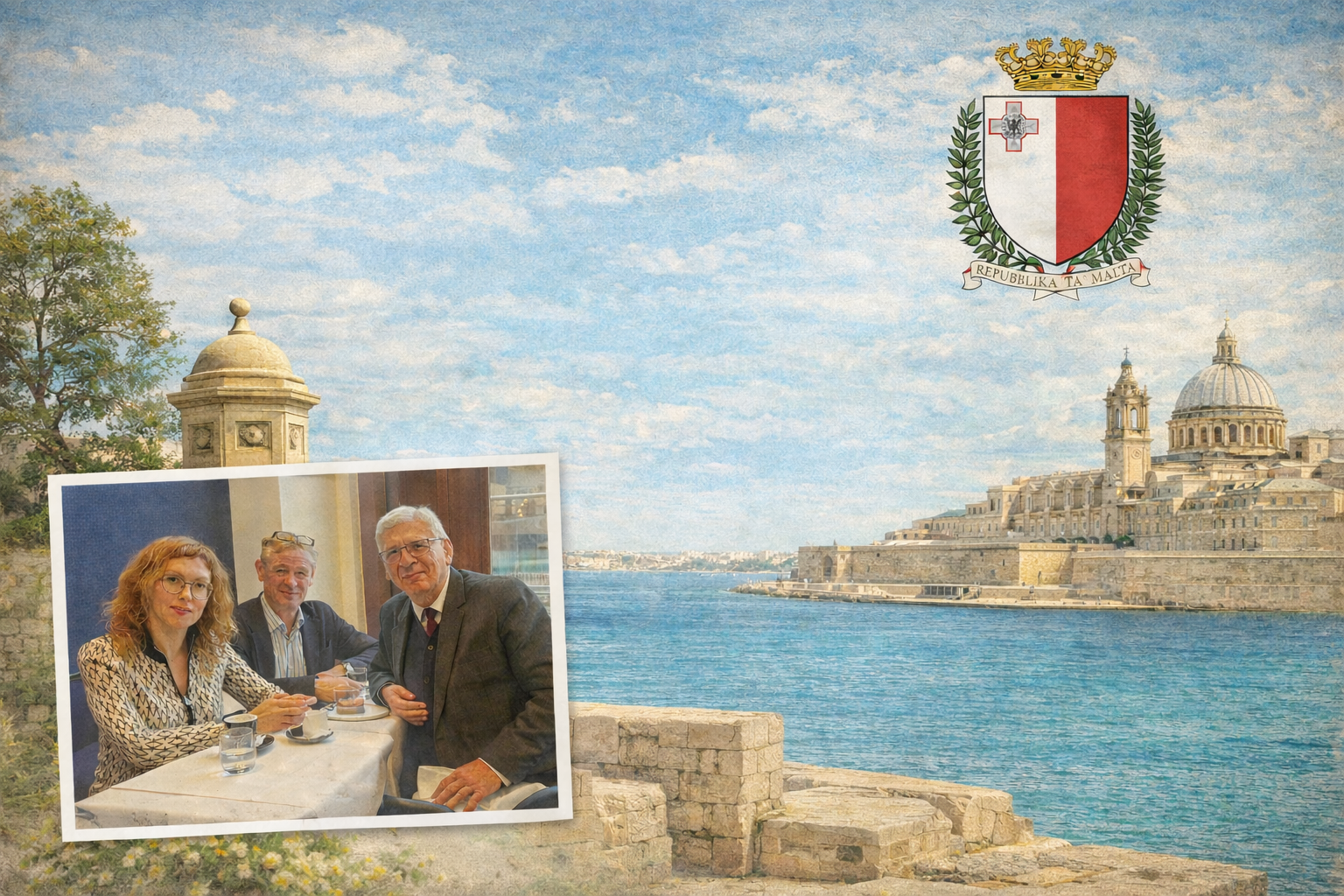
The Geneva Centre for Neutrality (GCN) recently convened a meeting in Geneva bringing together Jean-Daniel Ruch, Co-Founder of the GCN, Alexander Sceberras Trigona, former Foreign Minister of Malta and a central architect of Malta’s constitutional neutrality, and Katy Cojuhari, Head of International Cooperation at the GCN.
The exchange focused on contemporary neutrality in general and current practice in Switzerland and Malta, as well as its relevance and application in other countries amid growing global tensions. Participants underscored the corresponding increase in the value of neutrality as an active and constructive policy choice - one that can contribute more credibly to preventive diplomacy, mediation, and the peaceful settlement of disputes.
The discussion built on recent reflections by Dr. Trigona, including his presentation at King’s College, London on Active Neutrality: The Strategic Role of Neutral States in an Age of Conflict, delivered alongside the Ambassadors of Ireland and Austria. There, he outlined the Prospects for Neutrality calling for closer collaboration among neutral states and with partners such as the GCN - whether as a nascent “Club of Neutrals” or through individual efforts.
Among the proposals he highlighted were:
Strengthening engagement with the United Nations. Promoting a close and friendly working liaison between neutral states and the United Nations, including support for the UN Secretary-General and relevant offices such as the Mediation Department, in line with Chapter VI of the UN Charter on the Peaceful Settlement of Disputes and UN General Assembly Resolution 71/275 (2017), which specifically encourages the constructive role of neutral states.
Establishing an Annual Neutrality Index/Neutrality Yearbook. Publishing a regular, descriptive monitoring tool assessing the performance of formally neutral and effectively neutral states, as well as the conduct of third states in their relations with them. The Index would document the dynamism of external pressures - diplomatic or otherwise - faced regularly by neutral states and their own strategic responses thereto, as a tangible contribution to peace.
Updating the Hague Neutrality Framework. Launching an academic and policy review, initially with legal and international relations scholars, to modernize the neutrality provisions of the Hague Conventions and related instruments. This preparatory work would pave the way toward a future UN-mandated Hague Review Conference and the adoption of a “Hague II Neutrality Protocol.”
These reflections also echoed Dr. Trigona’s earlier academic contribution at Kyoto University, where he presented a historical paper on “Codifying Malta’s Neutrality” at the conference Reimagining Neutrality & its Research
In that context, he specifically recommended bringing the process of updating the Hague Conventions back to Geneva - by institutionally linking such efforts with the UN Office for Disarmament Affairs and the Conference on Disarmament—thereby returning to the historical roots of the Hague framework with a renewed commitment to peace. The meeting concluded with a shared assessment that 2026 will be a pivotal year for deepening work on neutrality.